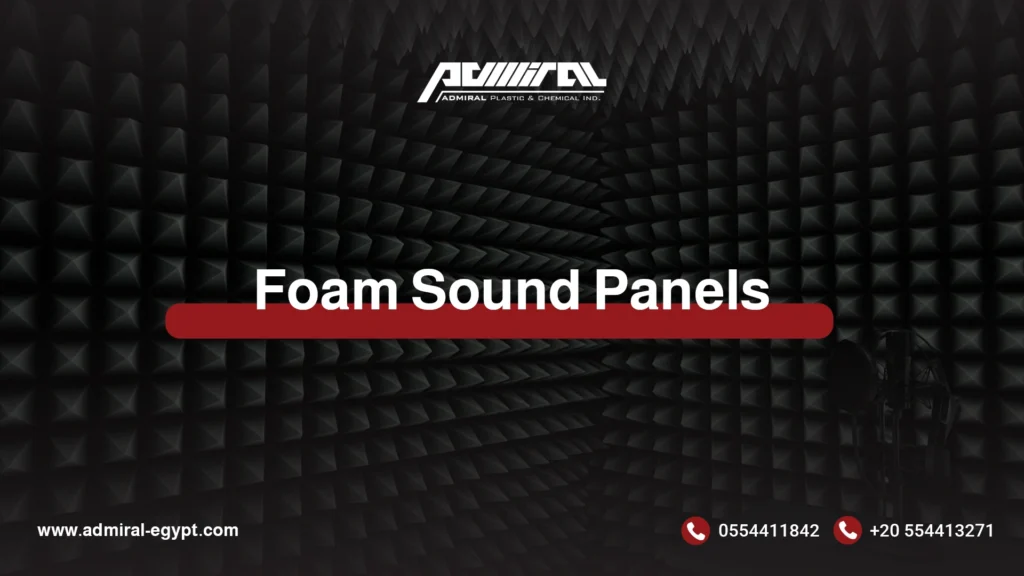
Foam sound panels are among the most effective and accessible tools available for controlling unwanted noise whether the problem is sound bleeding between rooms, echo making a space difficult to work in, or external noise disrupting sleep and concentration. However as one of the most poorly understood aspects of interior specification acoustic treatment remains. A lot of space is used with the wrong product, at the wrong place, and at the wrong time. This guide explains the basics, where acoustic panels actually count and it will assist you to define the correct solution to each circumstance.
Two Different Problems: Sound Absorption vs. Sound Transmission
It is necessary to know what problem you are solving before specifying any acoustic treatment since they are not treated with the same product or solution.
Sound absorption solves what occurs within a room. Hard surfaces concrete and glass bounce sound energy resulting to reverberation and echo which makes speech less clear and music less correct. Acoustic wall cladding and foam sound panels placed strategically within the room absorb that reflected energy, reducing reverberation time and improving the acoustic quality of the space.
Sound transmission deals with that which is relayed between rooms footsteps through a ceiling, conversation through a partition wall, exterior facade traffic noise. Mass and decoupling of the structure by dense materials and isolation breaks is needed to reduce transmission. An acoustic panel of any weight will never resolve a transmission issue in its own right, and the specification of a lightweight one there is a widespread and costly error.
Understanding NRC: The Number That Tells You How Well a foam sound panels Absorbs Sound
Noise Reduction Coefficient (NRC) is the standard of sound absorption performance of a panel. It has a score between 0 and 1: the more absolutely reflective a surface is, the larger the score 0, the more absolutely absorptive a surface is, the larger the score 1. Most quality foam sound panels achieve NRC values between 0.65 and 0.95, depending on thickness, density, and surface texture.
Greater NRC translates to greater sound energy taken per square metre of installed panel that translates to a reduction in the number of panels required to create the same acoustic outcome in a particular room. In comparing products, always seek the tested NRC value, never an account given by a manufacturer regarding acoustic performance.
| Panel Type / Thickness | Typical NRC Range | Suitable Application |
| Thin foam panel (10–20mm) | 0.40–0.60 | Light echo treatment, offices |
| Medium foam panel (25–50mm) | 0.65–0.80 | Recording booths, meeting rooms |
| Thick acoustic board (50–100mm) | 0.80–0.95 | Studios, screening rooms, auditoriums |
| PVC foam wall cladding (12mm) | 0.35–0.55 | General interior noise reduction |
Placement Strategy: Where Acoustic Panels Make the Most Difference
The location of a noise-reduction panel is as significant as the NRC value of the panel. Most energy of sound reflections is seen on surfaces closest to the source of sound and on the initial reflections of the walls and the ceiling directly beside, above and opposite the source. The following are the priority locations:
- First reflection points Reflection point on each side wall at a studio or a listening room, the point at which the audio emitted by the speakers is first reflected towards the listener. The treatment of these two points alone gives a disproportionate result of clarity.
- Rear wall a well treated rear wall averts the high reflection which causes the most dangerous interference of direct sound in both recording and listening conditions.
- Ceiling cloud a panel array suspended over the main listening or working location lessens ceiling reflections but does not cover all the surfaces, maintaining some liveliness in the room.
- Corner bass trap low-frequency corner build-up of sound traps in room corners; thick sound-absorbing boards installed floor-to-ceiling in corners solve the issue of bass build-up in corners that thinner panels do not penetrate.
You can follow: large foam board
Space-by-Space Acoustic Guide
Home Recording Studios and Cast Podcasting Rooms
A recording studio does not require silence but a controlled reverberation that is a short, and even decay, that is non-colouring the recording signal. Foam sound panels at 50mm or above on the side walls and rear wall, combined with corner treatment, typically reduce reverberation time to the 0.2-0.4 second range that most home studio engineers consider workable. The ceiling cloud makes the room feel as though it is acoustically dead but it does not make the room dull.
Open-Plan offices and Co-Working offices
The main acoustical issues in open-plan working conditions are speech privacy and concentration. Sound-absorption boards built into suspended ceiling system, partition screens and feature wall installations minimise reverberation that causes every conversation to be heard in the room. Research has always indicated that the lower the reverberation in open offices, the higher the reported scores on concentration were (by 20-35%).
Home Cinemas and Media Rooms
The absorption and diffusion absorption required in the home cinema include fluttering echo and side-wall reflections so that the rear wall should be diffused to give the impression of spaciousness on the surround field. The use of the acoustic wall panels on the side walls and the use of a diffusion element at the back side provide the balanced effect without the clinical impression of a fully deadened room.
Multi-Family residential and Apartments
Impact noise floor above, furniture movement and footsteps of people on the floor above is the most prevalent acoustic complaint in apartment buildings. Foam panels on walls are useful in airborne sound in the apartment, but to reduce the transmission of impact caused by the above, the treatment is necessary in the floor plane: not only wall-mounted panels, but resilient underlays and decoupled flooring systems.
Purchasing Acoustic Panels: Four issues to get straight
- What is the problem? Echoing in a room, reverberation in a room? This answer dictates the use of absorption or transmission-loss wall system.
- What is the desired reverberation time? Studio 0.2- 0.4s; office 0.4 – 0.6s; living room 0.5 -0.8s
- Which surface area should be treated? An audible improvement in a hard-surfaced room would normally require at least 25-30 percent of total room surface area.
- Does the panel have to be decorative? The finish of acoustic wall cladding is as significant in residential and hospitality environments as the NRC value both should be set together.
PVC Wall Panels of Admiral: Wall Panels of PVC Acoustic and Aesthetic Performance
Admiral Plastic and Chemical industries produce PVC foam panels and wall cladding products which add to the interior acoustic performance and provides the waterproof, fire-retardant and antibacterial qualities that construction and interior design projects demand. Admiral, which is located in the 10 th of Ramadan City, provides certified panel products to residential developers, commercial contractors and interior designers within Egypt and the region at large with comprehensive technical data sheets.
Quieter Spaces Start with the Right Specification
Noise is one of the most consistent sources of dissatisfaction in both residential and commercial interiors and one of the most solvable. Foam sound panels, correctly specified for the actual acoustic problem and positioned at the right points in the room, deliver a measurable and immediate improvement in comfort, privacy, and usability that no amount of additional furniture or soft furnishing can fully replicate.
Need acoustic panel recommendations for a specific project? Contact Admiral Plastic & Chemical Industries for product samples, technical specifications, and project-specific advice on wall panel selection.
Frequently Asked Questions
What are foam sound panels used for?
Foam sound panels are used to reduce echo, control reverberation, and improve sound clarity within rooms such as studios, offices, and home theaters.
Do foam sound panels block noise between rooms?
No, foam panels are designed for sound absorption داخل the room, not for blocking sound transmission between rooms. Proper soundproofing requires dense materials and structural isolation.
What is NRC and why is it important?
NRC (Noise Reduction Coefficient) measures how effectively a panel absorbs sound. The higher the value (e.g., 0.80+), the better the sound absorption performance.