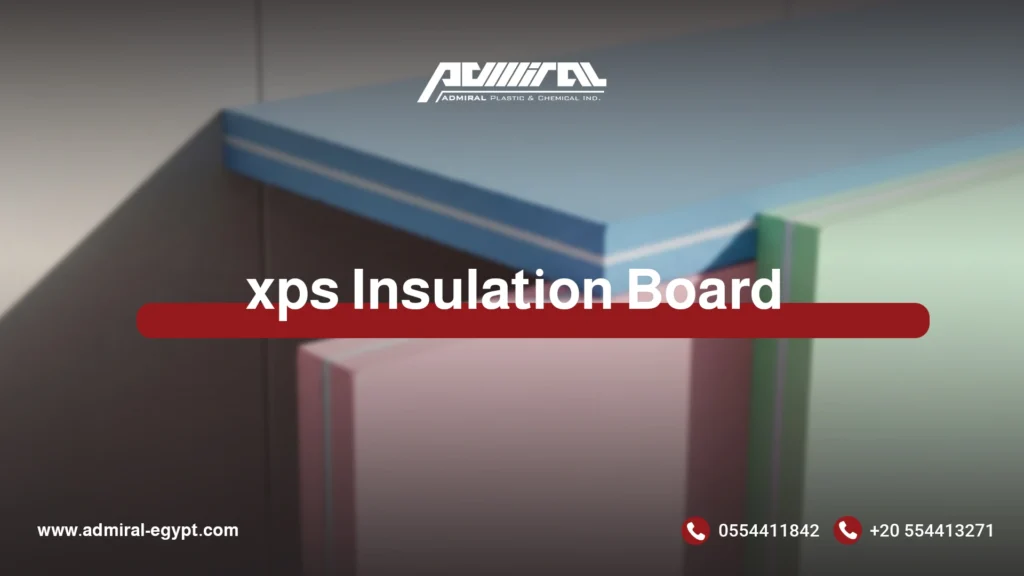
XPS insulation board is not a universal product, it is a specialist one. In locations where rigid insulation boards perform well under dry and above-grade environments, extruded polystyrene board was developed with the unique requirements of where adequate is not sufficient: continued contact with water, high compressive forces, and long burial in the ground. Under such circumstances, a replacement of a lower cost product does not result in a small penalty performance instead it results in a slow malfunction which is costly and disruptive to correct. This guide describes the science, the applications, and the detailing that gives XPS the only defensible specification in such circumstances.
The Closed-Cell Structure
The defining characteristic of XPS insulation board is its continuous closed-cell matrix. Compared to EPS which is made out of fused beads that have microscopic spaces between them, the extrusion process results in having a board where each cell is completely sealed there are no fissures by which the liquid water or the water vapour can penetrate into the body of the panel.
The applied implications of such an organization are important and quantifiable. Water absorption tests in the case of long term where boards are placed in water and put under pressure are invariably showing that XPS absorbs less than 0.5% of its volume in water. Absorption of EPS under identical conditions is 2-5 percent, based on density and condition of the surface. The difference is not dramatic until you take into account that each percentage point of water absorbed will be substituted by an equal volume of still air the real insulating substance within the board by an infinitely more thermally conducting liquid.
In an EPS board, where moisture uptake is considered alone, there will be a loss of 15-25% of original thermal resistance in an EPS board over a decade in a wet environment. Even in the same position, a properly specified rigid XPS panel will maintain virtually all of its original performance.
You can follow: polystyrene insulation board
xps insulation board Advantage
Compressive strength is the second great benefit of extruded insulation sheet compared to other rigid boards. XPS boards come in a 200 kPa to 700 kPa compressive strength the stronger grades that can support the weight of heavy vehicular traffic without appreciable deformation throughout the life of the design of the assembly.
| XPS Grade | Compressive Strength | Typical Application |
| XPS 200 | 200 kPa | Pedestrian areas, green roofs, light loads |
| XPS 300 | 300 kPa | Podium decks, inverted roofs, car parks (light) |
| XPS 500 | 500 kPa | Heavy-duty car park decks, industrial floors |
| XPS 700 | 700 kPa | Airport aprons, heavy infrastructure loadings |
The choice of the preferred grade at which the imposed load is to be applied is a structural specification rather than a cost optimisation choice. Compressive grade that has been under-specified results in creep deformation at constant load gradual compression of the board that decreases thermal performance and drainage capacity of the assembly on top of it.
Applications Where XPS Insulation Board Is the Only Correct Specification
Inverted Roofs
The waterproofing membrane is applied directly on the structural deck in an inverted roof system, and the insulation board is overlaid on it at the mercy of rain water, ponding and drainage water flow. Any other insulation material is incapable of working in this position, in the long-term. This is because XPS thermal board has a closed-cell structure, which enables it to shed off water and keep it dry at all times, preserving the membrane underneath and keeping the thermal performance of the assembly unimpaired.
Green Roofs and Podium Decks
The green roof systems and podium deck gardens both place a sustained moisture and heavy compressive load on the foundations of the weight of growing medium, water retention layers, planting and in certain instances pavement or light vehicle traffic. The panel is a stiff XPS at the correct compressive grade that is placed underneath the drainage and growth layers which bear the weight of the structure without deformation and give a waterproof insulation to the structure below without water in the wet layers above.
Construction of Below-Grade Walls and Basement
Below-grade walls are externally insulated and exposed to hydrostatic pressure, soil moisture and in certain soils, hostile chemical conditions. Polystyrene board bonded at the outer surface of a basement wall and then backfilled gives continuous insulation and some mechanical protection to the waterproofing layer are accomplished by the dimensional stability and moisture resistance only the closed-cell structure offers.
Cold storage and Controlled-Environment Facilities
Cold storage rooms, refrigerated warehouses and controlled-environment agriculture buildings are insulated facilities that must retain their performance qualities with respect to long-term temperature differentials and the thermal cycling that occurs with defrost cycles. XPS insulation board at high compressive grades is the standard specification in these facilities the thermal performance does not degrade over years of operation, and the boards resist the moisture that migrates toward cold surfaces in humid climates.
How to Detail XPS Correctly: Four Critical Points
- Not butt joints Lap joints rather than butt joints boards must be laid with staggered lapped joints in multi-layer assemblies, so there are no straight-through thermal bridges along the board edges; butt-jointed single-layer installations form an unbroken cold line across the assembly at every joint.
- surface The extruded polystyrene used is UV extruded; it will not withstand long-term exposure to ultraviolet light and all installations where the board is to be exposed before the finish surface is applied should be covered to prevent exposure to UV light.
- stipulate the appropriate choice of drainage layer in inverted roof constructions, a filter fleece between the XPS board and the ballast or growing media stops the fine particles to move into the drainage plane to block the drainage route that maintains the membrane dry.
- Match board grade to imposed load cannot be upgraded on site; before ordering compressive grade can be upgraded before ordering the wrong grade and replacing the grade under load which causes deformation visible in months and cannot be reversed without stripping the assembly.
The Cost of Getting It Wrong: What Failures of Substitution Look Like
In a moisture critical application, failure mode of substituting XPS with EPS or a lower grade board is hardly abrupt. It is tedious and progressive: the more water absorbed, the more thermal performance gets compromised, the more energy the building uses, the condensation starts to show on the indoor surfaces, and the waterproofing membrane which is now thermally strained by the deteriorating insulation above or below the membrane finally collapses. The rectification entails removing the roof or floor assembly to the structure and commencing afresh.
Economy vs. Rightly specified extruded insulation sheet: the difference between the cost of an insulation sheet that has been correctly specified and the cost of a cheaper insulation sheet is usually 20-40 percent per board. Full roof strip and reinstatement are orders of magnitude more expensive and that does not take into account the inconvenience to occupants of the building or reputational cost to the contractor.
Admiral: Certified Rigid Insulation Boards for Demanding Applications
Admiral Plastic & Chemical Industries manufactures certified PVC foam and rigid insulation boards from its facility in the 10th of Ramadan City, Egypt the largest industrial hub in North Africa and the Middle East. Products are produced to consistent quality standards with full technical certification, and the Admiral team is available to advise on product selection for specific project conditions and loading requirements.
Specify It Once, Specify It Right
In the applications where XPS insulation board is the correct choice, it is the correct choice by a significant margin not a marginal one. The closed-cell structure, the compressive strength grades, and the long-term moisture resistance are not incremental improvements over alternatives; they are the properties that make the assembly function as designed for its full service life.
Working on a moisture-critical or high-load project? Contact Admiral Plastic & Chemical Industries for certified product data, compressive grade recommendations, and project-specific technical support.
Frequently Asked Questions
What is an XPS insulation board?
XPS (Extruded Polystyrene) insulation board is a rigid insulation material with a closed-cell structure, designed for high moisture resistance and high-load applications.
What makes XPS different from EPS insulation?
XPS has a continuous closed-cell structure that prevents water absorption, while EPS has an open structure that can absorb moisture over time.
Can XPS insulation handle heavy loads?
Yes, XPS boards are available in high compressive strengths (200–700 kPa), making them suitable for applications like car parks, industrial floors, and infrastructure.